آنچه در ادامه می خوانید
During the second Pahlavi, Habib Sabet Pasal [3] was changed into one of the greatest capitalist of Iran. Some called him the greatest capitalist of Iran after the Shah possessing ten percent of everything in Iran.[1] [4]
The American magazine “the Fortune” announced in 1974 A.D. that Sabet possesses ten percent of the Iranian wealth practically; from banking and construction to exergy and pharmaceutical companies. Nearly, most of business arenas and industry of that time of Iran were possessed by him. Sabet Pasal’s palace Tehran was the symbol of luxury of that time.
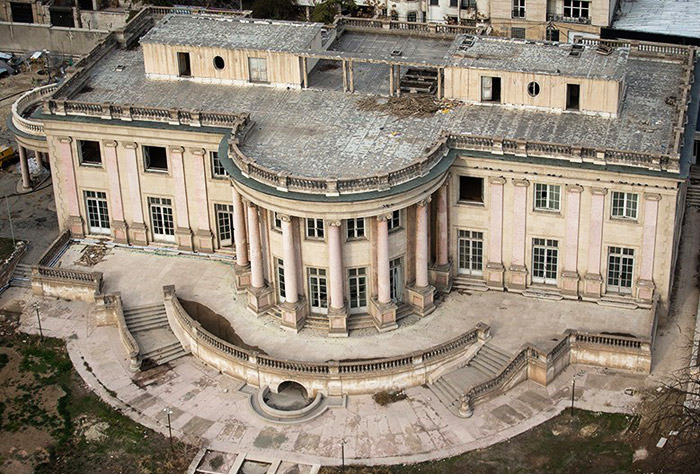
Meir Ezri, the representative of Israel in Pahlavi government writes pointing out Habib Pasal’s background:
“During previous decades, the Baha’is could call most Jewish families in Hamadan and Kashan to their creed. One of the Jewish people who could become wealthy turning to Bahaism and got famous was Sabet Pasal from Hamadan city. He was a driver in the midst of World War II and could become wealthy during a short period of time.[2] [5]
In 1975 A.D., the News Week got surprised of his success and wrote that this imperial and self-taught Iranian person is an eccentric one from a poor family without governmental relationships and also from a Baha’i family.
Supported by the Baha’i organization, the court and the Pahlavi government, Habib Sabet could possess more than 70 commercial great companies and nearly 20 great companies of assembly and providing American products such as General Tire and Pepsi Cola in various cities of Iran. [3] [6]
Of course, it should be paid attention that the benefits of these economic activities were spent for Bahaism ideal.
Habib Sabet used those benefits to expand the Bahaism cult’s thoughts and benefits in Iran and across the world; including:
– Extensive financial aids to build the national assembly of Pakistan [7]
– Constructing the veranda of the highest position in Kermel mount.
– Constructing Hazirtul Qods of the Baha’is of India
– Constructing the Downing place for the Mention of God of the Baha’i continental temples in Santiago (Chile)
– The Baha’is temples in Egypt, Australia and Jordan
– Purchasing lands around the Haziratul Qods of Tehran city
– Building walls around the lands of the Dawning place of the Mention of God in Lavizan locality of Tehran city.
– Additionally, hundreds of other measures done secretly”.[4] [8]
However, a great part of these capitals were being used in accumulation and development of economic activities. Some of the companies and institutions possessed by him or shared included: The Industrial Bank of Iran, The Iranian Mine and Industry Bank, the commercial and production institutions, Pepsi Cola, the cement of mashhad, Plasco Kar, General Tire and Ruber, Iran Farvag, Sycab and France Peik.[5] [9]
He also took over the dealership of Dodge car, several kinds of television and refrigerator great company of tire making, General Tire and several hard sugar company. He was the owner of 41 commercial companies having nearly ten thousand employees.[6] [10]
Habib Sabet was the member of the managing board of Iran and England bank, Iran and the Middle East bank and eventually the member of Masonry Lodge, Lions and Rotary clubs in Tehran. The central core of Rotary of Iran club was established in Farwardin 1335 S.H. and Habib Sabet was one of the members of the founder board.[7] [11]
The Baha’i capitalists during the second Pahlavi period of time were increasing their wealth using banking system rant. They were establishing banks accessing the governmental and foreign capitals easily and taking loans from the banks where they themselves were of the most important stockholders.
As a matter of fact, they exploited using these means for their personal usages and their related companies and banking system rant. In his diaries, Abul Hassan Ebtehaj points out this issue:
“Some of wealthy people and influential ones who had gained enormous wealth supported by Pahlavi government were wishing to own Banks.”[۸] [12]
Sodagar points out the capitalists well who withdrew their capitals out of their accounts and the companies’ deposits as soon as they felt dangerous and they were managing the companies by huge loans which they had taken from banks and also by enormous money which they had deposited in their personal accounts.[9] [13] As Sodagar believes Sabet was of those capitalists.
Habib Sabet gained the shares of several banks having capitals and influence. In 1338 S.H., the founded the Iranian mine and industrial development bank cooperated by some Iranian capitalists such as Habib Elgarian and Ebtahaj. Interviewing with the way of life periodical, Sabet stated the goal of establishing this bank as follows: “One of my important measures supervised by Mahdi Samiee has been the formation of the Iranian industrial development bank. Such bank was needed to be founded to develop the Iranian industries… A large number of people had committed to invest in this bank, but enough money wasn’t gathered. I said there that I would sell all of my properties to establish this bank if it is necessary.
Eventually, the industrial development bank was established and the Iranian industries which was developing owed this bank. When the bank was established, the foreign government and other countries loaned this bank and the businessmen and gave us numerous loans and we could create great industries in Iran.[10] [14]
Meantime, the establishment of the bank and being the member of board of directors created numerous rants for him through which he could omit his rival out of the scene.
In addition to the shares of the Iranian mine and industry development bank, Habib Sabet was of the stockholders and members of the board of directors of Iran and the Middle East bank.
Source: Reza Qaribi, the Baha’i wealthy people and Pahlavi regime, pp. 197-203.
Keep in touch with us: bahaismiran85@gmail.com [15]
[۱] [16] The memoirs of Farah Pahlavi and I, Alexander Doldom, vol.3, Tehran: Beh Afarin, 1377 S.H., p.307.
[۲] [17] Who is Meir Ezri, from you and from all of his tribe, the first notebook, p. 331.
[۳] [18] corruption architects, vol.1, p.34, the periodical of historical studies, year 5, No. 20, Spring 1387, p. 232.
[۴] [19] Ismaeel Raeen, branching in Bahaism, p. 362-363; the memoirs of Farah Pahlavi and I, vol. 3, p. 1333-1334; corruption architects, the agents’ visage and Rotary clubs in Iran, vot-3, pp. 40-41.
[۵] [20] Shapour Lavasani, the government and governorship in Iran during the period of time of the dominance of Colonialism and capitalism, Tehran: Shama’ publishing house, Bita, pp.181-184.
[۶] [21] Mostafa Al-Moti, Iran in Pahlavi era, 1369-1373, v.11, p.37; Alexander Doldom, the memoirs of Farah Pahlavi and I, vol.3, p.1316.
[۷] [22] Amir Abbas Hoveida narrated by SAVAK documents, Vol. 1, p. 121; Masonries, Rotaries and Lions of Iran, 1333-1357, p. 187.
[۸] [23] Pahlavi era men narrated by SAVAK documents, 29th book, Habib Sabet, p.370.
[۹] [24] Muhammad Reza Sodagar, the growth of Capitalism relations in Iran, Tehran, Thought flame, 1369, pp. 480-481.
[۱۰] [25] The corruption architects: The appearance of the agents of Rotary clubs in Iran, vot.3, p. 39.