
“Minority problem” is one of the important one of the contemporary governments and nations. The researchers believe that the minority problem is a political one; it means that in the framework of minority policy makings of governments and it is so-called included in political domain and it inevitably happens in the territorial range of a country. So, minority is eroded and confronted by governmental power, and its approaches and policy makings.
Other reasons can be found for the are importance of minorities, threatening and misusing of foreign forces which are looking for finding a way to influence on communities and governmental policies and minorities are selected as easily-accessed aim to influence and are considered as the most important concerns about this problem.
Also if the mutual relations of minority-majority are not truly managed, it can endanger validity and authority of a government. Religious minorities follow these accusations as one of minority Kinds.
The pundits who are interested in “minority problem” have suggested various theoretical models to investigate and recognize the governmental policies towards religious minorities which can content relations between minority and majority, too. However, these models are supervising special areas.
Due to religious geopolitics of the Middle East, the minority problem in this region is more than other regions.
Some researchers believe that minorities have caused restlessness in the Middle East even more than the problem of Arabs and Israel.
Bahaism in Pahlavi and Qajar periods of time:
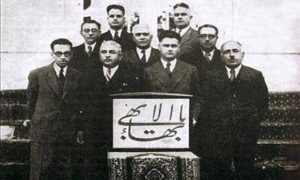
Bahaism was formed during Muhammad Shah Qajar in 13th century. Babis were the forerunners of the Baha’is.
Babis ran four aborted riots against Muhammad Shah in which they were repressed and exited from Iran.
The first factor which caused Babis to be repressed by Qajar government was feeling political and social insecurity.
Some believe that Babis played a key role in constitution revolution.
When Pahlavi dynasty was established in 1304 S.H., the regime considerations was generally revolutionized towards minorities and particularly the Baha’is. The unstable position and social of the country after World War I caused a kind of insecurity due to the presence and activities of foreigners in the form of religious schools and foreign embassies. So, Baha’is were restricted by Reza Shah’s irreligious government. Reza Shah took strict positions against the Baha’is. Thus, Baha’i schools were closed and the Baha’i national assemblies were suspended. Reza never recognized Bahaism formally and was constantly calling it a cult and party.
It is interesting to be noted that Bahaism attempt to develop and expand his religious and administrative system was at the same time with Reza Shah’s gaining power in the beginning of the present century.
Reza Shah’s dethronement on Shahrivar, 1320 S.H. relative caused the Baha’is to exploit the relative free atmosphere like social and political forces in Iran. They restarted their activities.
The years 1320 to 1332 S.H. are very important from the view point of the campaign between minority and majority and represent theological contradictions of the Iranian community well. However, the interesting thing is that the Baha’i community provided necessary support for itself to participate actively in public domain during these years exploiting the lack of political formal repression and in the circumstances of the then government.
The 25-year periods of time after the coup started with 1333 Ramadhan events. The mentioned event was not an untimely one, but in a short-termed look, it was originated from the transformations of 1330s, anti-Baha’i activities of forces and the Islamic movements.
In this event, some Baha’i administrative and religious places such as Haziratul Qods was destroyed. The Baha’i-resided localities in some cities like Shiraz were attacked and publishing Baha’i magazines were prohibited. Regime was afraid of losing security and tranquility of the country. It just put the riot to lower.
The establishment of Pahlavi kingdom can be considered as the onset of formal and clear fulfillment of policies to separate religion from government, diminishing the roles of scholars in public and political domains, reforming educational and judiciary systems to decrease the role of religious leaders.
Thus, the first Pahlavi is the founder and the first formal executor of the policies which are based on Secularism ideology. Muhammad Reza stabilized his father’s achievements more using variant means. Establishing new justice department was of the first measures of Muhammad Reza. Ho found out that judicial reforms are first steps in achieving his goals.
After judiciary, it was education turn whose most prominent measure is establishing Persian language academy in 1314 S.H. During the second Pahlavi kingdom, this approach continued. Establishing religious (theology) sciences colleges, establishing religion corps alongside with kmowledge corps for educating formal religion desired by the government in villages, controlling the religious schools via foundations like SAVAK and controlling financial and economic resources of theological schools and market were of such measures.
The court won competing with forces like feudals. measures favee of The court did the following measures in favor of itself which included: Meddling with elections to control parliament, executing modernism policies to weaken and limit the power of traditional and religious power like market traders, repressing nationalist opponents, army’s purge of national and leftist forces executing the program of white revolution.
To achieve the above-mentioned goals, the court provided new means such as establishing “Modern Iran Party”. This party was paid attention by the Baha’is. Six people out 20 members of executive board were Baha’is. Also; in the cabinet introduced to parliament by Mansour, 7 members out of 25 ones were Baha’is. The Baha’i members of the party were strengthened in 1343 S.H. when Mansour was killed.
In determining the aforementioned policies, just as the nature of the regime and the structure of the state played a decisive role, on the other hand, the issue of the Baha’i minority also played a role. However, with the fall of the Pahlavi dynasty in Bahman 1357, this opportunity was lost along with the achievements of the Baha’i community, and the events that followed created completely different conditions for this minority, which have similarities with the Qajar period and the early years of the present century.
Source: Chamankhah, Leila, Baha’ism and the Pahlavi Regime, Tehran: Negah Moasar, 2012, pp. 181-189.
Keep in touch with us: bahaismiran85@gmail.com



