
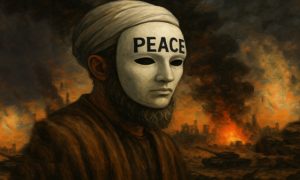
The world of 2025 stands not as a beacon of peace but as a monument to human hypocrisy. Geopolitical tensions deepen, economies falter, and societies fracture under the combined weight of deceitful diplomacy and self-serving morality. According to the World Economic Forum’s latest report—drawing the insights of over 900 global risk experts—state-based armed conflict has overtaken every other concern as the most immediate risk. Nearly a quarter of respondents foresee greater fragmentation and conflict, and they are not wrong. From Ukraine and Sudan to the burning Middle East, the cries for peace are drowned by the drums of war and the silence of the complicit.
It is often claimed that religious leadership can play a moral role in peacebuilding. Yet history shows that moral authority, when corrupted by politics, quickly turns into moral theatre. While leaders like Pope Francis once mediated between the U.S. and Cuba and moderate Indonesian clerics countered violent ideologies, others have betrayed their own principles for proximity to power. Nowhere is this betrayal more visible than in the Baha’i cult, which preaches Universal Peace but practices Universal Hypocrisy.
Bahā’u’llāh—who audaciously claimed to be the long-awaited savior destined to bring eternal peace—died leaving behind no peace, no unity, and no fulfilment of divine promise. His followers, instead of introspection, now desperately search for a worldly power to carry out their failed prophecy. If divine power has left them, perhaps they hope the United Nations, the United States, or even Russia might assume the role of global redeemer.
Their own texts betray them. Bahā’u’llāh showered praise on imperial powers—those very engines of war and oppression he claimed to oppose. His glorification of the Russian Empire’s intervention in his release exposes how easily lofty ideals were traded for earthly favor:
“His Imperial Majesty, the Most Great Emperor—may God assist him!—extended to Me… his protection.”
A similar tone of servitude echoes in `Abdu’l-Bahā’s supplication for the British monarch:
“Oh Lord! Give grace to the great Emperor George V, the King of England… and keep permanent his towering shadow on this lofty land.”
These words—offered to empires drenched in blood—reveal the hypocrisy behind their so-called principle of universal peace. The English, Ottoman, and Russian regimes were busy enslaving nations, looting wealth, and spreading war while these “spiritual leaders” prayed for their prosperity. Why would any prophet of peace invoke divine favor upon warlords and colonizers?
The hypocrisy deepens. On ۲۷ April 1920, Abdu’l-Bahā accepted a **knighthood from the British Empire**—a regime that, during the **Great Persian Famine (1917–۱۹۱۹)**, caused millions of deaths through greed and mismanagement. Are we to believe that a power so ruthless suddenly grew a conscience because of Abdu’l-Bahā’s charitable acts? Or was this knighthood a convenient alliance—a mask of piety covering political cooperation?
The Baha’i claim that “peace requires action, not words.” But where is that action today? Their leadership preaches silence in the face of genocide, neutrality in the face of oppression, and detachment in the face of injustice. Their social media platforms remain mute while the world burns—especially in Gaza, where even secular nations have found their voices. Yet when persecution involves Baha’is in Iran, they suddenly rediscover activism, outrage, and memory. Selective morality, selective peace.
Their own recent communication—the Universal House of Justice’s letter dated 26 May 2024—lays bare their confusion. It instructs Baha’i youth not to criticize or condemn any government and instead merely “feel the pain” of global suffering. This instruction directly contradicts `Abdu’l-Bahā’s earlier assertion that knowing good is not enough; one must act. How can a faith claim to champion peace while forbidding its followers from standing against war?
When the victims are others, they preach patience. When the victims are their own, they preach protest. The hypocrisy is staggering. The same letter glorifies “the sacrifices of Persian Bahais” while remaining utterly indifferent to the massacres and atrocities committed elsewhere. They rewrite history to portray themselves as eternal victims while avoiding accountability for their own political alignments.
Ultimately, the failure of Bahā’u’llāh to establish the promised Universal Peace exposes the truth: his message was not divine revelation but human ambition. The Universal House of Justice, his so-called successor, continues the charade—issuing hollow statements, performing moral theatrics, and protecting institutional interests under the guise of spirituality. Behind the polished rhetoric lies a system built not on peace, but on power, manipulation, and moral convenience. In the end, the Baha’i Faith stands not as a movement for peace but as a monument to hypocrisy—a cult that exalts self-interest while preaching altruism, that praises oppressors while claiming divine compassion, and that silences its followers while pretending to be the voice of conscience. Universal Peace, it seems, was never their principle. It was their camouflage.
Keep in touch with us: bahaismiran85@gmail.com



