
Revitalizing the tendency towards ancient time and the history prior Islam have been the common aim of the ministry of the British colonies and Masonry organization in Iran and other Islamic countries. This movement in the contemporary history started from Akhond Zadeh, Melkom Khan, Agha Khan Kermani and etc. and other Masonries like Muhammad Ali Foroughi and Hassan Pir Nia persisted it. The aim of this movement was to introduce Islam as the destructive element in the Iranian history and to state this issue that the history of Iran prior Islam is more brilliant than Iran after Islam. To prove this fictitious historical hypothesis, all pens ran.[1]
Proselytizing Liberalism and Reformism in political field, preaching deism in religious fields, preaching cosmopolitism in cultural field and preaching indulgence[2] and tolerance in social field. The result of these measures in the Islamic communities will end in collapsing religious culture and educating the community people based on what are against valuation in the western communities.[3]
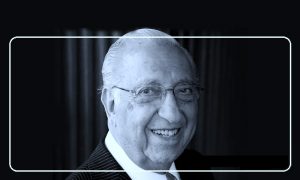
One of the instances of this approach during Pahlavi regime is Haushang Seyhoun’s function who is of the architects of the deviant cult of Bahaism. Seyhoun was of the most active members of Rotary and the member of the founders’ board of Rotary in the north of
Tehran city.[4]
Houshang Seghoun was born in a Baha’i family in 1299 S.H. in Tehran city. His father was of the Jewish people who had joined the deviant cult of Bahaism. After getting Diploma degree in 1319 S.H. he entered into the university of Tehran to study architecture course in the fine arts college.[5]
The hidden Jewish and the expansion of Bahaism:
At that period of time, the French government bestowed the scholarships to several students and dispatched them to France. In this way, Seyhoun went to France to continue his education.
He attached very much to Andreh Godar, the French freebooter of the Iranian cultural heritage and was of the politicians of architecture college of Tehran university. He has stressed this note repeatedly in his interviews and speech before and after the revolution.[6]
After finishing his educations, he came to Iran in 1328 S.H. and war immediately employed at university having lecturer degree and taught.[7]
After Andreh Godar, Mohsen Foroughi took over the chairmanship of the fine arts collage of Tehran university. He had close relationships with smuggling bands of ancient works. Due to embezzlement and enormous misuses in Senate parliament project, he was dismissed.[8]

However; during corrupted Pahlavi regime, dismissal of a manager due to financial corruption was not justifiable. A though this measure was influential in creating positive view in public minds, but it wasn’t the main reason. A person who was more dependent than Foroughi must have managed this college and he was Houshang Seihoun. He was an architect who was the best choice according to the French politicians to be the manager of the fine arts college due to his studies in the fine arts college, France and his membership in the deviant cult of Bahaism.[9]
He was the founder of university students’ trips and camps and every year various groups of male and female university students were being sent in a mixed form to so-called scientific trips to various parts of Iran.[10] These trips were done to disseminate corruption among the university students. One of the students says in this regard:
“In these trips, the students were drinking alcohol openly and the method of making alcoholic beverages were trained.”[11]
Taking drug abuse by some students which ended in their death[12], using bare models of women in classes[13] and encouraging the students to drink alcoholic beverages and kidding sexually[14] were of the measures of Houshang Seihoun during his teaching periods of time and managing the architecture college of Tehran university.
As the architect of the deviant cult of Bahaism, Seihoun was following two major aims: 1) Keeping the students away from the social issues and combatting atmosphere of those days in Tehran university.[15] 2) Destroying the characters of the Iranian artistic youth.

Seihoun’s dependence on Bahaism and his membership in Rotary club and his extreme closeness to the court caused him to progress rapidly. He escaped from the country after the Islamic Revolution due to his numerous corruptions and immoralities.
Houshang Seihoun has designed seven historical works of famous Iranian people whom according to him, he has exhumed them:
– Avicenna tomb in Hamadan city, 1330S.H.
– Kamal Al-Molk tomb in Neyshabur
– Khayyam tomb in Neyshabur
– Nader Shah Afshar tomb in Mashhad, 1342,
– Reconstruction and designing Ferdowsi tomb in Mashhad 1342,
– Tous Museum Construction, 1347
– Sepah Bank building in Tehran, 1347
The reason for his statement that said: I have exhumed them is that all of these famous people were of the Islamic scholars such as Avicenna. In all these architectures, there isn’t any sign of religion, and Islamic culture. He has omitted the religious and Islamic dimensions out of the identity of these great famous people and there is not any sign of the Iranian Islamic architecture on their graves.
Top of Form
Bottom of Form
Top of Form
Bottom of Form
[۱] Works were written like the kings’ bibliography by Jalal Al-Din Mirza who is of the pupils f Melkom and Akhond zadeh written to praise the Iranian kings before Islam, Love and manliness by Abul Hassan Foroughi written to praise the ancient Iran from Parviz to Changiz by Taghi Zadeh, the ancient Iran by Hassan Pir Nia, Pahlavi dictionary by Parviz Khanlari
[۲] Islam is the religion of leniency and this is different from indulgence intended by Masonries which means indifference with beliefs and duties.
[۳] Najafi Moses, Faghih Haghani Moses: The history of political transformations of Iran, the institute for the Iranian contemporary history, Fall, 1391 S.H., p. 670.
[۴] Rotary club in the north of Tehran city, the third Rotary club established in the north of Tehran city in 1339 S.H. and was accepted as the member of international Rotary in Isfand 1339 S.H.
[۵] Corruption architects, the visage of the agents of Rotary clubs in Iran, Vol. 4, the office for researches of Keyhan institute, Tir, 1389 S.H., p.74.
[۶] Bani, Masood, Amir, the contemporary architecture of Iran, century architecture art publishing house, 1388, p. 275.
[۷] Houshang Seyhoun’s biography, of the documents of the fine arts college
[۸] Masood Akbari Yeganeh, what did the fine arts college do during Pahlavi regime in the Iranian architecture, Keyhan newspaper, No.20628, 1392/08/08, p. 8. (university)
[۹] Some people believe that Seihoun’s dependence on Bahaism and his membership in Rotary club cause him to progress rapidly and to be the head of the fine arts college and some believed the reason is his closeness to the court.
[۱۰] corruption architects, the face of Rotary club agents in Iran, vol. 4, Keyhan institute researches office, Tir, 1389.
[۱۱] The influence of the western culture and art in the Iranian contemporary painting, p.135.
[۱۲] corruption architects, the face of Rotary club agents in Iran, vol. 4, Keyhan institute researches office, Tir, 1389.
[۱۳] Circular letter of the fine arts college for painting & sculpture course, No.636.
[۱۴] Corruption architects, the face of Rotary club agents in Iran, vol. 4, Keyhan institute researches office, Tir 1389, p. 80.
[۱۵] Ettelat, year: 1350 S.H., p. 341.
Keep in touch with us: bahaismiran85@gmail.com



