
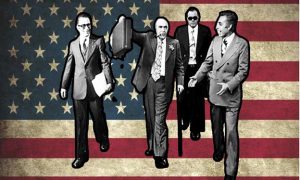
In addition to England and Israel, the United States of America also had extensive transactions with the Baha’is. The relationships between the Baha’is end the government of the united states of America aren’t limited to 1340s or 1350s, S.H.; although it culminates during these two decades, but it should be paid attention that America was the first country where recognized the Baha’is endowments formally.
According to Islaeel Raeen: “The acceptance and identification of the Baha’i endowments and cancellation of dues and taxes which was approved by the local governors of states according to one course during the years 1928-1929-1935-1339 and formal documents of 1941-1942, the Baha’i endowments belonged to the central assembly of the Baha’is of America or was registered by the name of Bahaism community companions.”[۱]
In 1340s; during the honeymoon of Iran and America relationships, the American president Lyndon Johnson gives a speech on Oct. 6, 1967 A.D. on the occasion of the centennial anniversary of the establishment of Bahaism which indicates the position of the Baha’is, this minority group in Iran in the foreign policy of America:
“I am pleased to congratulate the centennial anniversary of one of the events of the eventful history of the Baha’i faith and I declare that your attempts cause for benevolence to be preached and your aim is kindness and the seed of right and justice which has been scattered by you will benefit the humanity world so much.
Your aim is the same as America’s and your hope is all benevolent people’s ones. The American nation tries to create a world where is in lack of enmity and spite and all human beings traverse the peace path to live in freedom, understanding and esteem.
All thoughtful and provident people arm complimenting and lionizing the Baha’i religion; because each of us is waiting for a day when the earth become a hometown and all human beings become its inhabitants.”[۲]
In the documents of the American embassy in Iran, it is mentioned that the Baha’is were influential in the level of the decision making of the Iranian government and this was clear and obvious for the Americans”.[3]
For instance; in one of the documents of the spying nest of America in secret level, the Lieutenant general Ayadi has been mentioned and he is mentioned as one of the dealers and intermediators of the United States. A person who possesses 15 to 40 percent of Pars oil company stocks.[4]
The really remarkable note is that the documents remained from the American embassy in Tehran city evaluate the dimensions of Iranian people’s pessimisms against the corruption of the governmental system of Iran after stating the position of Ayadi as the main course of the economic activities of the Shah:
“During the recent weeks, the financial corruption has become one of the main issues of Iran. The greatest criticisms against the Shah are related to illegal activities of his relatives and even this family members.
As a rule, this problem can’t be solved easily and it will just be solved when the basis of the most fundamental practical foundation in Iran; that is Kingdom, has been Shuddered.”[۵]
Ayadi wasn’t the mere Baha’i thimblerig of the Americans in Iran. At the beginning of 1340s and territorial reforms in Iran and particularly by the establishment of progressed center which later on provided the opportunity for greater organization called the modern Iran party, the Americans could penetrate into Iran and among the Baha’is more.
Manouchehr Shah Qoli: was one of the members of the progressed center and later on he became the member of board of directors of Iran Novin party. He was close to Amir Abbas Hevayda and wars of the executors of American policies in Iran.[6]
Of course; before the extensive influence of America, people such as Abul Hassan Ebtehaj were of the supporters of American policies.
The remarkable note about Ebtehaj is that he was active as the agent of England in Iran as long as it was the superior power of the international system. Additionally, when the English were replaced by the American, he adapted himself and was acting as the agent of the American.
He had proved himself for the American by expressing his satisfaction with Mosaddegh’s national government and accompanying with coup plotters by participating at the universal bank.
In his memoirs, Ebtehaj stresses this note that Henderson, the American ambassador stresses the necessity for his returning to Iran during Mordad 28 coup to improve the coup government’s financial position. They even attracted the Shah’s satisfaction to make him return.[7]
Even in executing the policies of principle 4 of Truman, they turned over the aids bestowed by America to the Iranian government to a Baha’i Jewish person called Dr. Zabihullah Corban as their trustee in Iran.[8]
It seems, the Baha’is like Habib Pasal played a kay robe in the expansion of foreign investment related to Iran; as negotiations were posed in a meeting between the representatives of Rockefeller foundation with Habib Sabet and Ali Amini.[9]
In 1340s, Mansour Rowhani became more dependent on foreign investment. Rowhani has turned over all operations related to researches and control of roads and dams and civil plans which must be investigated by the technical laboratories inside the country to tis interested company (the foreign companies).
Sultansh company was one of them which has taken over the research and laboratorial operation in Lar, letiyan, Minab, Jiroft and Karoun dams.[10]
Rowhani explicitly believed that “entering foodstuff was not an stigma.”[۱۱]
It can be concluded that the Baha’is were practically stepping on the direction of this policy of America: “Make bankrupt, make a loan and rule.”[۱۲]
According to documents of Pahlavi government periods of time, the durability of Hoveyda’s 13 years of being the prime minister must even be searched based on the Baha’is policy and capitalism cartels. As Tajul Molouk, Muhammad Reza’s mother explains, Muhammad Reza was to depose Honveyda, but he couldn’t practically stand against the western oil cartels which were inclined the continuation of prime minister’s presence.[13]
In his cabinet, Hoveyda was defining the main policy making on the basis of the Baha’i agents to such an extent that there were seven Baha‘i ministers in one of his cabinets.[14]
Muhammad Reza Pahlavi also believed that: “If a person like Amir Abbas Hoveyda is the Iranian prime minister, the Americans and the British will be secure.”[15] The remarkable note is that in the delegacy of the Iranian national aviation in London, New York, Geneva, Zurich, Vienna, Frankfurt and etc. The Baha’is had occupied the positions.[16]
Theologically, what joined the Baha’is and the westerners and their benefits was the cosmopolitan approaches of the Baha’is.[17] Although it seemed it was a false cosmopolitan ideology for both groups that even they didn’t believe in it, they exploit it just to achieve their interests.
Meantime, what was deepening the presence of the Americans in Iran was the Mason movements and people like Ighbal, Sharif Imami were supporting security, political and economic presence of America in Iran alongside with the Baha’is.
As during Manouchehr Ighbal’s premiership, the limitation for foreign investment in the Iranian bank was cancelled. Additionally; in 1330 S.H., 40 percent of the stocks of industries and mines bank were turned over the Americans.
To figure out the benefits of the west in Iran, it is necessary to know that according to the calculation of the magazine called “the international life”, the total interest sum and interest gained by the foreign companies in 1338 S.H. in Iran has been about a billion dollars and if this sum was divided among the Iranian people whose annual income was 130 dollars a year, the annual income in Iran would become 180 dollars a year.[18]
Of course, Parviz Qorji, the editor-in-chief of Tehran Mosavvar magazine says:
“Hovryda is insidiously sabotaging behind the oil negotiations among consortium representatives in increasing the extent of production and increasing the Iranian income. Due to his friendships and several-year relationships with consortium members, he wants to cause Dr. Ighbal to fail in oil negotiations in order to be replaced by Dr. Ighbal and also to be appointed as the head of oil national company due to pressure or consortium pressure and so the agreement of production and extra income of oil to be achieved by Hoveyda.”[19]
Source: Raza; Qaribi, the wealthy Baha’i people and the Pahlavi regime; pp. 43-80.
Keep in touch with us: bahaismiran85@gmail.com
[۱] Ismaeel Raeen, branches in Bahaism, Raeen research institute, p.246.
[۲] The faith news, Bahman-Isfand 1346 S.H., No.11-12, pp.556-558.
[۳]The documents of the American spying nest, the students who were obeying Imam’s right side, Tehran, spying nest documents, No. 37, the political creeds of colonialism, p.7.
[۴]The documents of the American spying nest, the students who were obeying Imam’s right side, the 2nd book, Tehran: The political researches and studies institute, 1386 S.H. p. 419.
[۵] Abbas Milani, Hoveyda’s puzzle, pp. 348-349.
[۶] Hussein Abadiyan, the last two decades of Pahlavi government, Tehran: The political researches and studies institute, 1383 S.H., p. 271.
[۷] Abul Hassan Ebtehaj, Abul Hassan Ebtehaj’s memoirs, p.293.
[۸]The architects of corruption; the look of agents and Rotary clubs in Iran, pp.71-72-75.
[۹] Keyhan, Shahrivar 6, 1340 S.H., p.16.
[۱۰] Hedayat Allah Behboudi, rereading the case of a minister: Mansour, Rowhani, the historical studies periodical, No.1, Tehran: 1382, p. 178.
[۱۱] Ettela’t newspaper, 1353/10/29, p-4.
[۱۲] Falling, the investigation of the reasons for collapsing Pahlavi Kingdom, 1384, PP. 583-584.
[۱۳] The memoirs of Pahlavi queen, the interviewer: Maliheh Khoroudad…, Tehran: Azin, 1380 S.H., vol. 2, p.230
[۱۴] The memoirs and biography of Dr. Seyyed Ibrahim Chehrazi, attempted by Morteza Rasouli Poor, Tehran: Nogol publishing house, 1382 S.H., pp. 128-129.
[۱۵] The memoirs of Farideh Diba, translated by Dr. Elaheh Raees Firouz, Tehran, 8th edition, Tehran, Beh Azin, 1381. S.H., p.624
[۱۶] Homayoun Keshtgar, the honeymoon of Pahlavi regime and the Baha’is, the contemporary history of Iran periodical, No.50, p. 412.
[۱۷] Ehsan Tabari, the Iranian community during Reza Khan, 1356 S.H., Bija, Bita, pp.118-119.
[۱۸] Ibid, p. 583.
[۱۹] Pahlavi era men narrated by SAVAK documents; Amir Abbas Hoveyda, vol.1, Tehran: the center for investigating the historical documents of the intelligent service ministry, 1382 S.H., p.252.



