
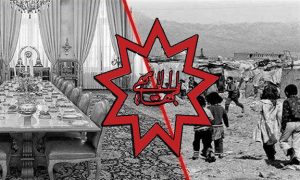
The Bahaism cult possesses a multi-layered influential nature and has been influential in most political and economic transformations of the contemporary history of Iran particularly during Pahlavi periods of time. They strengthened the economic bases of the Iranian economy in the related development orbit by entering foreign capitals and western used technologies.
Apart from the economic consequences of related development, the bases for their meddling with policy arena of the country was provided by entering multi-national companies and foreign governments.
Alongside with multi-national financial companies, the financial department related to local capitalism gradually tried to influence on national decision making and to act as executive arm of them.
The acquired findings are as follows:
I) Although Bahaism leaders state they don’t meddle with policy, the historical evidence prove contrary to this claim. The active presence of the members of the cult in 3rd of Isfand 1299 S.H. coup, the change in kingdom from Qajar to Pahlavi and 28th of Morded 1332 S.H. coup are parts of clear interference in the Iranian political sky.
When Pahlavi dynasty gained power, a new period of Bahaism dominance on Iran started. After World War I, the British policies changed from Indian subcontinent to the Persian Gulf and its oil-rich areas. So, they were going to create a central government and the powerful one to supply their profits in Iran.
To fulfill this important aim, Bahaism cult introduced Reza Khan as the savior of the future of Iran. When Raza Khan gained power, Bahaism possessed the political rent cooperating with its stepfather, England.
This trend was accelerated after Mordad, 28 coup to such an extent that Bahaism and its members changed into one of dominant forces in various parts of regime by dominating on the pillars of Pahlavi regime and gaining political and economic positions particularly during Hoveyda’s premiership periods of time.
The capitalists who were related to this cult and were supported by the interior elements and exterior agents’ back up deepened their
influence on the pillars of Pahlavi government. Depending on its power, the Bahaism cult gradually preached the lifestyle and culture of consumerism in the Iranian community and provided the bases for forming capitalism by entering goods extensively.
Abdul Karim Ayadi, Sabet Pasal and Hojabr Yazdani were of the pioneers of this important issue.
II) The investigation of the kind and the method of the economic activities of the Baha’is during Pahlavi government particularly after Mordad 28, 1332 S.H. coup indicates the cooperation and interaction of the members of this cult, with Pahlavi regime and foreign agents of multi-national companies.
According to SAVAK documents in 1340s and 1350s S.H., two factors drove the benefits of the public to margin and caused Pahlavi government to distance from the community more: the international capitalism and the local
one.
Preserving the triangle of local government, local and international capitalism caused Pahlavi regime to be dictator more. In spite of the increase oil incomes, this increase never became the drive motor of development and eventually it ended in economic gap. A process which was evident from the years after 1332 S.H. coup.
According to the existent evidence cloud about the Baha’is and Hoveyda as the Iranian prime minister during 1340s and 1350s, the Shah’s dictatorship mustn’t be considered as Hoveyda and his cabinet’s desires. The power and economy structures dominating on the community were inseparable.
Partiality and assembly and look of the Baha’is caused for the economic relationships of Iran not to be based on the national requirements and interests of the country, but it ended in benefiting international companies and dependence of Iran more. In analyzing the Islamic revolution from the political economy point of view, the Baha’is playing role in economy alongside with other local capitalism group caused for deep economic – social gap in Iran and is considered as of the reasons of the movement of Iranian people against Pahlavi government.
III) After Reza Khan gained power, the Baha’is were changed into one of the most powerful and wealthy capitalist minority in Iran establishing economic foundations and institutes such as Nownahalan and trustee companies. The method of those Baha’i economic institutes in economic missions had various forms which were related to the secret nature of the deviant cult of Bahaism.
In this method, their traces in economic activities didn’t remain and their capitals were active in the form of various people to provide Bahaism cult.
The economic existence of Habib Sabet Pasal is well indicating a triangle in which the internal capitalism, international capitalism and the government in developing counties find each other again and help each other.
It can be said that Bahaism cult was one of the powerful arms of international capitalism in Iran. To figure out the relationship between Pahlavi government and Bahaism better, Habib Sabet, Abdul Karim Ayadi and Hojabr Yazdani’s activities are clear examples of using rent and influence of Bahaism in the government.
Under the Shadow of Pahlavi government, Habib Sabet Pasal succeeded overnight; so that, his economic and political conditions during 1340s and 1350s were dramatically different comparing those of 1320s.
As a matter of fact, the development of Sabet Pasal’s companies is an example of the Baha’is conditions during Pahlavi’s periods of time.
Ayadi resembled a local businessman in the triangle of local government, local capitalist and foreign agent and played a role in leading Bahaism organization in economic, military, security and cultural aspects. His special portion in Pahlavi court gave complex and enigmatic nature to his economic bustles.
To execute the universal house of justice aims, this prominent broker of Bahaism tried hard to make Iran dependent on the international capitalism. His management method was a mixture of corruption and inefficiency.
It may not be exorbitant to be said that one of the factors for weakening kingdom position among people of all walks of life is Ayadi’s function and his position in Pahlavi court.
Hojabr Yazdani wasn’t excluded to this rule. As a Baha’I capitalist, businessman and representative, he had a really good relationship with another two sides of the related capitalism economy; that is, the government and international capitalism.
Using the gap existing in the banking system during earlier 1350s and Pahlavi court, government and SAVAK’s security system’s support and back up, Yazdani owned a legendry wealth and eventually changed into an economic hub.
Personal profits and Bahaism cult interests and strengthening the relationships of the triangle of capitalism, business, the government and international capitalism. His function provoked enormous sensitivities for the public thoughts and eventually one of those who played a key role in falling Pahlavi regime and the deviant cult of Bahaism was Hojabr Yazdani.
IV) The consequence of Bahaism economic activities during Pahlavi government was the emergence of crisis and problems in the economic structure and partly non- economic one of the country including:
– The expansion and deepening dependence on foreigners through immethodical imports of foreign products
-Deranging in monetary and banking system
-Money Laundry.
-Exiting capital from the country.
– Receiving eccentric loans without paying back
– Creating crisis in nutritious products
– Damaging agriculture and animal husbandry departments through territorial reforms
– Irregular imports of nutritious products
– Damaging the environment
– Organized crimes
– Bribery
– Smuggling
– Making army dependent on foreign countries to provide medical and military equipment and nutritious products
– The Baha’i agents such as Ayadi, Hojabr, and Sabet Pasal played key roles in deepening the economic problems and in preventing progress of Iran. The close relationships between the deviant cult of Bahaism and Pahlavi government was so that no name is merited for this government but usurp system of government.
Source: Reza Qaribi, the Baha’i plutocrats and Pahlavi regime, pp. 307–۳۱۲٫
Keep in touch with us: bahaismiran85@gmail.com



