
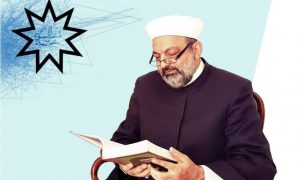
About Sheikh Alauddin Ze’tari
Sheikh Alauddin Zetari is the master of Al-Jenan university of Terablos and successor of Syria mufti, the manager of judicial decree and religion teaching office in endowment ministry of Syria. He has written various scientific works in religious jurisprudence and theology do mains including ” Muslims in challenge world”, “The comprehensive religious jurisprudence with reason”, “the encyclopedia of the contemporary financial transactions”, “correlation insurance” and ” stating the kinds of transaction from the legitimate commandment point of view”.
Sheikh Ze’tari, the head of decree house of endowment ministry and the assistance of the greatest mufti of Syria, too. He had social intercourses with the religious and proselytizing foundations of Iran very much and he was active in very conferences and affairs related to the approximation of religions.
One of the claims by Bahaism cult is ending Islam’s period of time and the excommunication of Islam, while the investigation of the Baha’i commandments and rules is not similar or related to Islam and its advanced commandments. The critical investigation of the Baha’i commandments shows that most of these innovative and invented basics are in lack of cognitive, jurisprudent and Islamic supports.
For this reason, they have created many problems for the Baha’is to such an extent that some of these commandments have been modified, changed or omitted. The following text is Sheikh Alauddin Ze’tari’s criticism, one of the Sunni scholars and officials of Syria concerning the contradictions in the Baha’i commandments:
It is stated in the book Aghdas that 9 rak’ahs must be recited for God and at noon, in the morning and evening, the verses are sent down. Also, it is stated that at the time of prayer, the face must be turned to Aghdas.
These matters are against the essentials of the religion of Islam. The necessary prayers must be said 5 times round the clock. Additionally; each time, there are definite rakahs: 2 rak’ahs in the morning, 4 rak’ahs at noon, 4 rak’ahs in the evening? 3 rakahsat at dusk and 4 rak’ahs in the supper time. Despite of different schools, all Muslims agree on these principles.
The necessity for five daily prayers has been proved the holy Quran, tradition and consensus and this matter mentions these principles.
However, the reason from the book; so the Almighty God mentions the prayer in several parts of the holy Quran such as:
«و اقیمواالصلــوه»[۱]
“And maintain the prayer…”
“إِنَّ الصَّلَاهَ کَانَتْ عَلَى الْمُؤْمِنِینَ کِتَابًا مَوْقُوتًا”[۲]
“For the prayer is indeed a timed prescription for the faithful.”
And also:
«حَافِظُوا عَلَى الصَّلَوَاتِ وَالصَّلَاهِ الْوُسْطَى وَقُومُوا لِلَّهِ قَانِتِینَ»[۳]
“Be watchful of your prayers, and (especially] the middle prayer, and stand in obedience to Allah.”
«وَأَقِمِ الصَّلَاهَ طَرَفَیِ النَّهَارِ وَزُلَفًا مِنَ اللَّیْلِ إِنَّ الْحَسَنَاتِ یُذْهِبْنَ السَّیِّئَاتِ ذَلِکَ ذِکْرَى لِلذَّاکِرِینَ»[۴]
“Maintain the prayer at the two ends of the day, and during the early hours of the night. Indeed, good deeds efface misdeeds. That is an admonition for the mindful.”
The morning prayer is being recited in one part of the day, the noon and evening prayers are being performed in the other part of the day. “Ghadah” is the term used for the beginning of the noon till the sunshine setting and then it will Isha’ and is consisted of 3 Raka’hs.
The Almighty God states in the holy Quran, Asra’ Surah, verse 78:
«أَقِمِ الصَّلَاهَ لِدُلُوکِ الشَّمْسِ إِلَى غَسَقِ اللَّیْلِ وَقُرْآنَ الْفَجْرِ إِنَّ قُرْآنَ الْفَجْرِ کَانَ مَشْهُودًا»
“Maintain the prayer [during the period] from the sun’s decline till the darkness of the night, and [observe particularly] the dawn recital. Indeed, the dawn recital is attended [by angels].”
It is stated that:
«اقم الصَّلَاهَ لِدُلُوکِ الشَّمْسِ إِلَى غَسَقِ اللَّیْلِ وَقُرْآنَ الْفَجْرِ»
“Maintain the prayer [during the period] from the sun’s decline till the darkness of the night, and [observe particularly] the down recital.” which includes the noon and evening prayers and it is stated:
«و قرآن الفجر»
Or
«اقم قرآن الفجر و هو صاله الفجر»
That is, maintain the prayer at evening down and it is the morning prayer. So, it is proved that the morning, noon and evening prayers are necessary to be maintained and sunset and Isha’ prayers are proved by another reason.
However, the evidence from the prophetic tradition for the fivefold prayer:
It has been narrated by the messenger of Allah in the year of the Farewell Pilgrimage: “Worship your Lord and maintain the five daily prayers and be fast in the fasting month of Ramadhan and perform Hajj to the house of your Lord and pay the Zakat of your wealth willingly and obey the authorities of your religious affairs that you may enter the Paradise of your Lord!”[5]
Keep in touch with us: bahaismiran85@gmail.com
[۱] The Cow chapter, verse: 110.
[۲] The women chapter, verse: 103.
[۳] The Cow chapter, verse: 238.
[۴] Houd Chapter, verse: 114.
[۵] Ahmad Masnadeh (T 5.262). Al-Maynieh.



