
The hidden running about of the Bahaism cult to influence on the structure of Pahlavi government got gradually visible. The members of this cult could do basic measures in the arena of proselytizing thoughts and beliefs of Baha’i creed and the expansion and strengthen its economic measures emerging new conditions.
The more we approach the ending years of Pahlavi government, the more the Baha’i economic activities became secret and unclear due to various reasons. So, Baha’i heads hid leaking economic activities entitled trustee company and juvenile investment bank and its related collections.
To prevent the Islamic Iranian community not to be sensitive, they made economic activities taken over by trustful people.
Regarding the organizational structure of Bahaism, the members of the cult can be divided into two groups: elites and plebs. The elites are the first grade members who possess high organizational power.
In General, the Jewish Baha’is and the members of descendants like Nouri Effran and families belong to the first generations of Bahaism possessed high political economic power.
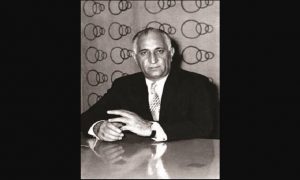
One of the members of Bahaism organization who played a key role in the development, strengthening and economic influence of this cult is Habib Sabet Pasal. Being Jewish and his dependence on Arjmand and Baqaraf families caused him to be assumed as of the high ranking elites of the Baha’is.
Sabet Pasal was of the Baha’is who tried hard to organize Bahaism economic organization on the onset of Reza Khan Kingdom.
His frequent tips to Haifa and visiting Bahaism heads in the occupied lands of Palestine, and being present in America, Europe and, his relationships with multi-national American and European companies made him famous as one of the main heads of Bahaism in Iran, to such an extent that after Shogi Effendi’s death in 1336 S.H. and changing the individual leadership to council one entitled “the universal house of justice”. Habib Sabet Pasal was appointed as the head of executive board of directors of “the Iranian trustees’” company.
Abrahamian considers Habib Sabet as of the group of old and prominent investors who has gained his wealth during commercial development periods of time during World War II and his next numerous wealth in the periods of time of increasing oil price during 40s and 50s S.H. [1]
The following is a brief report about his influence on Pahlavi government:
Habib Sabet worked in the shop of two Baha’i brothers called Muhammad Reza and Muhammad Tagi Tam who played influential roles in hit economic laying plots. Muhammad Tagi Tam was of the descendants of the Baha’i Ebtehajul Molk’s intimate friend and had a close relationship with Abul Hassan Ebtej.[2]
When World War I finished and the foreign troops left the country, Habib Sabet opened a bicycle making shop where he also rent automobile and bike in Shemiran Ave in front of Dowlat St. supported and cooperated by his master Muhammad Tagi Tam in 1298 S.H. He could learn to drive, there.
After a while, he was introduced by Muhammad Tagi Tam to Mirza Ahmad Qazvini, the consultant and head of Asef Al-Saltaneh real state to be the driver of Asef Al Saltaneh’s family.
Mira Ahmad Qazvini was of the Baha’i heads of Tehran city who selected the name Rasekh for himself later on. He was Shapour Rasekh’s father, the assistant of planning organization and the chairman of the center for Iranian statistics during Muhammad Reza’s periods of time.[3] Regarding the influential role of the Bahaism organization in the coup of Isfand 3, 1299 Sil., it seems the coup was one of the reasons for Habib Sabet to quit his education.
Sabet’s frequent trips to Haifa and visiting the Baha’i heads in the occupied lands of Palestine caused him to be changed into one of the Baha’i heads in Iran, later on.
Helped by his maternal uncle Mirza Rahim Arjmand, he took over the assistance of post, telegraph and telephone ministry during this period of time.
Generally speaking; regarding the nature of Pahlavi government and his relationships with the international system, post industry was expanded and paid more attention during Reza Khan’s period of time. In the structure of Reza Khan’s government, the Baha’is possessed high-ranking positions and people like Habib Pasal as the powerful economic arms of the Baha’is was supported by the members of Kingdom descendants.
In 1308 S.H., Habib Sabet got married with Bahereh, sayyed Ahmad Baqaraf’s daughter. Getting married with Bagraf family was really influential on political and economic fate of him during Pahlavi’s periods of time. The Baha’i brothers Bagraf who later on elected the surname Khamsi for themselves were of the most wealthy and influential Baha’is of Gilan and Tehran. For instance, Grand Hotel of Tehran who was considered as a European Hotel belonged to them.
One of the influential members of this descendants is seyyad Nasrullah who paid most of the expenses of Abbas Effende’s trips to Europe and America. He was of the influential and great members of the Baha’is and the member of the Baha’i assembly of Tehran city in 1300 S.H.
In Abbas Effendi’s trip to Europe and America, Seyyed Ahmad Khamsi accompanied him. Mahmond Zarqani, Abbas Effendi’s assistant in America and Europe trips writes in the note related to Rabiul Awwal 27, 1331 A.H.:
That day, Abbas Effendi was repeatedly granting the Excellency Seyyed Ahmad Baqraf who had specially come to Paris the previous day from Iran to visit Abbas Effendi.”[۴]
After Abbas Effendi’s death in 1301 S.H., the Bahaism organization was afflicted by basic transformations during Shoqi Effendi’s statesmanship and was formed as an official organization.
Habib Sabet emigrated to America along with his 4-people family in 1320 S.H. in the midst of World War I. In Hawaii, he visited Mrs. Agnes Alexander, one of the disciples of God’s faith.
Habib Sabet says about his emigration to America interviewing with the way of life magazine:
“When World War II happened, I thought to come to America with my wife and offspring to reside in America until the war ends.”
In San Francisco, Habib Sabet visited the Baha’is residing in America. He also participated at annual assembly of the Baha’is residing in America and started his economic activities aiming preparing the Iranian market for the American products in Rockefeller Plaza Street, No.30.
Source: the book “the wealthy Baha’i people”
Keep in touch with us: bahaismiran85@gmail.com
Top of Form
Bottom of Form
Top of Form
Bottom of Form
[۱] Ervand Abrahamian, Iran between two revolutions, translated by Ahmad Gol Muhammadi and Muhammad Ibrahim Fattahi, Tehran, Nashr-e-Ney, p. 531.
[۲] The autobiography of Habib Sabet, pp. 21-22.
[۳] Ibid, 55-58.
[۴] Badi’a Al-Athar, vol.2, p. 169.



