
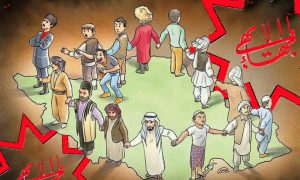
Discussing about Babis and the Baha’is roles and report card in the Iranian history has always been accompanied by challenging narrations. A collection of memoirs, documents and the historical researches have investigated the behaviors and functions of the followers of this movement and introduced it to have harmful effects in various cultural, social and security domains. This article is presenting a glance at some of these claims based on presented resources.
Stealing the ancient heritage of the Iranian people:
Narrated by Fadh Allah Sobhi Mohtadi, Some Baha’i activists were cheaply purchasing or stealing the historical works and ancient things and items during Pahlavi and Qajar period of time; to such an extent that even some endowed items like the door of Bibi Zobeydeh’s tomb has been disjoined and transferred.
In the book “the memoirs of decline and falling”; page 434, he says:
“… I remember well that long time ago, one or two Jewish Baha’i people collaborated with each other and headed off. Everywhere they found a sign of ancient time, they stole or purchased cheaply. One of them was a tailor and had a shop in Laleh Zar street… This man was too fearless in this job that one night he disjoined Bibi Zobeideh’s tomb’s door … Those days, I was Abdul Baha’s secretary. The man went to Paris from Haifa and Palestine ways. He had the audience of Abdul Baha! …”
Faking possession of the literary heritage of the Iranian people:
Muhammad Mohit Tabatabaee, the literary man and researcher consider the poem:
گر به تو افتدم نظر چهره به چهرخ رو به رو ….
as attributed to an anonymous poet called Taher Kashani and he believes that attributing it to Tahereh Qorratul Ein by the Baha’is is a kind of plagiarizing and cultural requisition.
The cultural deviation and titivating in Iran:
This Zionistic organization has even deviated in the architecture of the Iranian buildings such as the architecture of Avicenna tomb in Hamedan city and many Islamic scientific references and has tried to introduce them as a merely scientific reference without having Islamic natures. For example, Avicenna tomb in Hamadan city has been planned by a Baha’i architect called Seyhoun which is nearly in lack of Islamic nature and identity and this issue can be observable in some famous people’s works and tombs planned by the Baha’i architect Seyhoun.
Stealing Iranian people’s properties:
Abdul Hussein Ayati, one of the famous Baha’i people narrates in the book “Kashful Hiyal”: Even in the highest level of Bahaism leadership measures such as stealing people’s properties like Hajj Sha’ban’s precious pox and valuable belt of an Iranian businessman in Istanbul have been reported.
He narrates in Kashful Hiyal book, page 221: “Bahaullah guided his son Abbas Effandi to steal precious box of Hajj Sha’ban and stole the priceless belt of an Iranian businessman in Istanbul!”
The cultural overthrow of Iranian people:
Sobhi Mohtadi believes that the Baha’is were of the first groups who proselytized unveiling and free intercourse of men and women during the constitutional system. A movement which was formally executed by Reza Khan year later and was considered as one of cultural stroke over the Iranian community.
He writes in his diary, p.39: “The Baha’is in Iran were the first cult who posed unveiling and free intercourses of men and women as strangers entitled “women freedom”. During the constitutional system, an order was issued by Abdul Baha which prohibited the Baha’i women to veil. So, what was executed by Reza khan forcefully has not been unexampled; because during the constitutional system, the Baha’is had paced its first steps.”
The role in bloody and security tensions in Iran:
According to various resources which have pointed out the Iranian history in Qajar, Pahlavi and the Islamic Republic periods of time, the report card of Babis and Baha’is are full of bloody riots and battles: From Neyriz, Zanjan and Tabarsi fort to the assassination of Naseruddin Shah, their role in Amir the great’s murder, cooperating with the martyrdom of Sheikh Fadhl Allah Nouri and Seyyed Abbas
Behbahani and bloody events of Yazd and Shiraz cities and collaborating with most of the crimes committed by Pahlavi regime such as SAVAK crimes against the revolutionists, preaching laxity and etc.
In this bloody event, Bahaism is not considered as an intellectual group, but it is considered as a force which disrupted the general security of Iran.
Blemishing the independence and the country:
The second leader of the Baha’is speech concerning exploiting the Iranian underground resources by America and the Baha’is relationships with the Colonial powers indicate the good approach of this cult in helping with Aliens’ influence on the Iranian country.
On March 20, 1912 A.D. Abdul Baha made a speech in Washington about the history of the relationship between the east and the west: “I consider this assembly as the reason for the possibility of the eastern and western nations to be united in order for the complete relationship between Iran and America to be achieved, cos nothing is better than relating with America for the material progress of Iran. Also, no country but Iran is better for America to commerce and benefit.”
Eventually; according to various historical resources and famous people’s memoirs narrated from Bahaism inside, a clear image about Bahaism betrayals are being presented. An image in which there are collections of conflicting behaviors economically, culturally and politically.
Generally speaking, Bahaism is a forged western religion existing in the east and Iran. Bahaism started from a Jewish interpretation of Shia religion in Iran; that is, “Shia Protestantism”. Because Protestantism is the interpretation of the New testament (the Bible) with the Old Testament which has been created based on “German Nationalism” and Bahaism is exploiting the category of the Iranian nationalism. Consequently, the anti-Islamic policy of Bahaism has continually continued and confronted each cultural and political movement which is seeking for Islam in Iran. Now, this cult is being completely supported by America and Israel to confront organist Islam.[1]
Most of its followers are residing in America and in countries like India, Indonesia, and some Latin American countries. Basically, they don’t believe in hometown and have chosen so-called “cosmopolitan”. An issue which is totally against national security and interests of all counties including the Islamic Iran. Although they are claiming for not meddling with policy, but their aim is to establish the universal government of Bahaism.
Keep in touch with us: bahaismiran85@gmail.com
[۱]Forouzan Far, Morteza; Being familiar with Bahaism, Tehran: Heritage publishing house, 2nd edition, 1382 S.H., p.54.



