
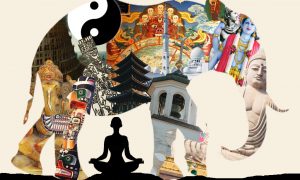
A cult without probative support-like Bahaism
Yoga itself is divided into various schools; including Raja Yoga, Hath Yoga, Karma Yoga, Bhakti Yoga, Jnana Yoga, and etc. Each of these schools has its own special viewpoints and methods, but all of them are shared in a final aim of achieving humanity with nature and the truth of the universe and spiritual awareness.
Traditionally, Yoga accepts various philosophical and spiritual viewpoints. That is, Yoga doesn’t necessarily stress on a special theological system and for instance it accepts various perspectives concerning the existence of God.
Pluralism is a false viewpoint that says all religions have a part of truth and eventually all people will be prosperous. This belief which believes in religious pluralism doesn’t consider any difference between believing in one Gods, two Gods or three Gods.
In one side, Yoga says achieving perfection and salvation is merely possible via Kundalini be awakening and this salvation will be fulfilled by performing sincere instructions of other religions.
So, why must have the simple orders of the divine religion be set aside for this aim and rather difficult practices and plans which take several years, a day till nine hours must be taken? Leave it alone that sometimes exercising Yoga practices have been considered as having mental and spiritual damages and it is said some Yoga doers here advanced to the point of have madness and nerve illness.
In Yoga, holy places like mosque and Husseinieh are not recommended as the place for worshipping God, spiritual growth and gaining God’s approval, but because human being needs pure vibrations and such vibrations are existent in mosques and holy places, so the person will be the center of attention by going to mosque.
From this point of view, there won’t be any difference between a mosque a church and if vibrations are found in idol house, it is allowable to go there!
It is frankly said in Yoga books that the remembrances are recommended as a kind of meditation in Islam. Even remembrance in Yoga has been interpreted as one of tranquilizing lingual methods. In this approach, the main aim of remembrance in Yoga is to organize mental distractions and to achieve tranquility.
Therefore, it will be unrealistic to expect that remembrance in Yoga to have deep cognitive support or lead to spiritual excellence. In Yoga, repeating words and phrases are important not their meanings. For this reason, it is important for the remembrance to be meaningful is or not or the remembrance is related to God or eloquent.
In Yoga, the remembrance is used to balance excitements and to set the mind not to bond the person with the meaning world. Also, the remembrance mustn’t be distracting. Thus; in some cases, it is better for the remembrance to be meaningless, too.
In Yoga, Pluralism; where each viewpoint view or method is considered as equally valid. This issue can weaken the ability for recognizing correct methods or interpenetrations from incorrect without clear criteria to evaluate and judge between a valid teacher or a fraud or an original school and a deviant version.
This issue can provide the opportunity to misuse or exploit. If each viewpoint is to be considered as valid, the values and basic moral principles claimed and defended by Yoga may also be weakened; because skepticism will prevail. This issue can lead to misusing Yoga concepts and decreasing its influence and will be in fact counterproductive.
In the commercialized world of Yoga, Pluralism can be used as a means for marketing and recruiting various addressees.
The superficial variety in styles and methods may be useful to recruit various people, but this kind of variety is in lack of validity depth and originality.
As a matter of fact, Yoga cult is in lack of demonstrable and philosophical basis like Bahaism.
It should be said that all newly-emerged deviant cults are in lack of demonstrable and philosophical basis without any exception.
The reason why some intellectual cults believe in Pluralism is that they themselves are in lack of demonstrable and philosophical basis.
Source: Mehdi Giasi Kargar Moghaddam, Yoga and Meditation, pp. 46-48.
Keep in touch with



