
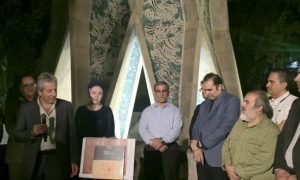
Unveiling the book Engineer Houshang Seyhour’s notes in Khayyam Neyshabouri garden
The head of cultural heritage, tourism and handicraft office of Neyshabour city said: “The ceremony of unveiling the book “the notes and manuscripts of engineer Houshang Seyhoun – the man of enduring architectural landmarks was held on his birthday attended by the governor of Khorasan Radhavi and Nader Seyhoun.
According to Miras Arya correspondent, Hassan Giyahi added today Shahrivar, 1, 1405 S.H: This excellent book which has been published by Rahseparan publishing house has been dedicated by Houshang Seyhoun to the Iranian children and architecture university students.
Also; Nader Seyhoun, Houshang Seyhoun’s offspring made a speech in this ceremony and said: My father always loved his notes and manuscripts to be printed and published in order not to be deviated by the passage of time.
Saeed Reza Doust the cultural consultant of the governor of Khorasan Radhavi thanked those who are in charge of publishing the book and said: This ceremony has been held ordered and followed up specially by the governor of Neyshabour. This is Neyshabour’s right to host such programs.
Houshang Seyhoun, the Baha’i of Jewish descent against Islam:
It is necessary to be noted that revitalizing archaism and pre-Islamic history is the common aim of the British ministry of colonies and freemasonry organization in Iran and other Islamic countries. This movement was started from Akhond Zadeh, Melkom Khan, Agha Khan Kermani and etc. in the contemporary history of Iran followed by freemasonries such as Muhammad Ali Foroughi and Hassan Pirnia. The aim of this movement is introducing Islam as a destructive factor in the Iranian history and stating this matter that the Iranian pre-history is Islamic is more brilliant than post Islam Iran. To prove this imaginary historical hypothesis, all pens worked.[1]
Advertising liberalism and reformism in political field, preaching deism in religious field, preaching cosmopolitism in cultural field and preaching tolerance in social field are the results of these measures in Islamic communities aiming collapsing religious culture and educating people of the community based on anti-values of the western communities.[2]
In 1347 S.H., Seyhoun became the head of urban planning and renewal council of Tehran city. When he was determining the borders of Tehran range, he put the lands belonged to kingdom descendants and people related to the court and super capitalists who were the members of Rotary inside the range. He arranged for highways to pass alongside these lands thereby causing their value to skyrocket increasing hundreds of times over-virtually overnight.
Seyhoun’s dependence on the deviant cult of Bahaism and his membership in Rotary club, and his extreme closeness to the court are of the main reasons of his promotions and this appointment as dean of faculty of fire ants. Due to his numerous ethical and financial transgressions, he fled following the victory of the Islamic Revolution. After the revolution, he emigrated to Canada and supported by some hostile cultural foundations. In 1393 S.H., Houshang Seyhoun died in Vancouver, Canada.
He considered it a point of pride to have embodied the Islamic-mystical dimensions of renowned Iranian figures-such as Omar Khayyam-through his architectural designs. It is noteworthy that Avicenna was, first and foremost, an Iranian – Islamic philosopher, with his other attributes-such his expertise in medicine – falling within the border scope of that identity. Howaever, unfortunately, Avicenna is primarily recognized in Iranian culture for his contribution to medicine and his mausoleum lacks per architectural elements reflecting an Islamic character.
Keep in touch with us: bahaismiran85@gmail.com
[۱] The works such as the Kings’ bibliography by: Jalal Al-Din Mirza, love and manhood play by Abul Hassan Foreughi, from Parviz to Changiz by Taghi Zadeh, The ancient Iran by Hassan Pirnia, Pahlavi dictionary by: Parviz Natel Khanlari
[۲] Najafi Mosa, Fagih Haghghani Mosa; The history of the political transformations of Iran, the contemporary history of Iran institute, Fall 1391 S.H., p.670.



