
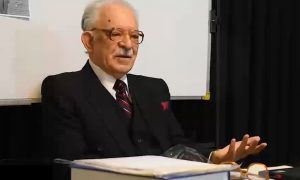
This note is investigating the position and the function of the intellectual elites of Baha’i background” in the contemporary Iran stressing on case study Yadullal Moughen, the Baha’i philosopher and translator. The aim is to go beyond a personal look and putting this character in a net of similar figures to achieve a systematic understanding of the relationship among “religious background”, “forming identity”, “producing cultural investment” and “mechanisms of media representation”.
Introduction:
The problem of Baha’i intellectual elite:
Concerning the study of cults, religions and sociology of elites, the method of forming and reproducing intellectual elites concerning Bahaism movement is a question. This question cannot be answered just by study of characters, but it needs multi-layered and contrastive analysis. The case study of Yadullah Moughen along with other similar characters can be done based on the following axes:
I) The relationship between family background and the scientific elections:
Is there any common pattern between the religious tendencies of family and selecting research subjects, translations and intellectual approaches of these people?
II) The medium representation:
Which image of these people is presented by the Baha’i community and aligned media?
Are they reminiscing as “cultural investment” and intellectualism symbols after forming and rupture theologically?
III) Critics’ narrative:
How do movements opposed to Bahaism exploit this intellectual background and report card in their analyses and criticisms?
Analyzing these cases isn’t merely possible depending on the formal texts of Bahaism and it needs an interdisciplinary approach including elites’ sociology, discourse and cultural studies.
II) After death narratives: reconstruction of a character:
After Yadullah Moughen’s death, various reactions showed that a unique character is being reconstructed in some various and sometimes contradictory narrative. These narratives are as follows:
A) Moughen, philosopher and translator:
Concentrating on scientific report card, his translations and philosophical specialization; trying to separate scientific character from each kind of religious or political attachment.
B) Moughen, from Baha’i background:
Stressing on his religious background and philosophical minority identity; high lighting him as an open-minded person having Baha’i background.
C) Critical Moughen:
Highlighting some of his political and intellectual positions which is different from governmental and governance-related approaches.
D) Under limitation Moughen:
Pointing out the security confrontation including investigating his house in 1399 S.H. and displaying the image of an open-minded character being under pressure.
E) Moughen as a symbolic component:
Using his name and photo in foreign media as a symbol to show desirability and position of minorities (particularly the Baha’is) in Iran or vice versa to criticize the current conditions.
III) Moughen in Iranian contemporary elite network from Baha’i background (the comparative analysis):
Investigating Yadullah Moughen in vacancy clarifies his personal dimension, merely; but putting him aside other contemporary intellectual figures having the same background (like Aramesh Doustdar) provides the possibility for accessing a “typology” of the intellectual elites which are related to this movement. This comparison shows that “the elites who are from Baha’i background” aren’t a uniform homogeneous block, but they form variant range of identity, political and intellectual tendencies. The comparative analysis of these figures can be problem-solver based on the three following axes:
I) Family background and lineage:
Both were born and grown in Baha’i families. However, Aramesh Doustdar left the Baha’i community in 1341 S.H. while there isn’t any information about formal exiting this community by him; although there isn’t any sign of his commitment to special religious movements in his intellectual report card.
II) The intellectual background and specialized courses:
Yadullah Moughen:
He was born in 1327 S.H. in Isfahan city. He got his B.A. degree in physics from the university of Hull, England and his M.S. degree in philosophy history and science from university of Leeds. He concentrated on translation and preaching modern philosophy of the west particularly the symbolic philosophy and science.
Aramesh Doustdar:
He was born in 1310 S. H. in Tehran city. He got his Ph.D. degree in philosophy from Bonn university, Germany writing his thesis about Nietzsche, the is famous culture for criticizing the religious culture fundamentally and posing concepts like “thought refusal” and “religious disposition”.
III) Relating with power structure and rival intellectual movements:
Moughen:
He was more active in the position of an independent translator and researcher in Iran and remained basically in scientific atmosphere and translation in spite of security-based contact (house investigation).
Doustdar:
He left Iran after the Revolution and criticized the Iranian culture and policy radically.
The investigation of Yadullah Moughen’s character as a case study presents important indexes about the relationship between “the religious background” and “producing cultural investment” and “media representation mechanism”. However, generalizing these results needs caution.
Source: Sarab-e-Haghighat
Keep in touch with us: bahaismiran85@gmail.com



